On korokoro sendari matōgi sowaka
〒773-0008 徳島県小松島市田野町恩山寺谷40
👁️ Street View in front of the temple 🧭 Directions with Google Maps (to the temple gate) 🚗 By car: to the car park 📍 Open in a map app
Temple map
Buildings found in OpenStreetMap. Faded: uncertain position. The map may be incomplete: a building missing here may still exist on site. See the temple in Google Maps ↗
Blue: trail from the previous temple · red: to the next temple · 🛖: henro goya (hut). Tap a trail to open Street View at that spot.
- Yado Bizan · 4,5 km · 5 000 ¥ · chambre individuelle
- km 6,8 · n°12 Bizan ヘンロ小屋第12号 眉山 · Street View
- km 3,5 · n°48 Kyōzuka-an ヘンロ小屋第48号 京塚庵 · Street View
🚗 To temple 19 Tatsue-ji : 4.7 km · 15 min by car
Pilgrims’ trail from OpenStreetMap; walking time computed from the terrain, plus half for breaks.
🗺️ All the stages at a glance: on foot or by public transport →
History
Origins and a closed monastery
According to tradition, Gyōki founded the temple under the reign of Shōmu (724–749), under the name Mitsugon-ji, and carved an image of Yakushi Nyorai against epidemics. The story tells of a ban on women beyond the Hanaori-zaka slope.
The visit of Kōbō Daishi’s mother and the lifting of the ban
According to this tradition, Kōbō Daishi withdrew here during the Enryaku era (782–806). His mother, Tamayori Gozen, who had come from Zentsū-ji, is said to have been stopped at the entrance. He is said to have practised austerities under a waterfall for seven days to have the ban lifted.
The tonsure and a son’s tribute
His mother is then said to have taken her vows and offered her hair to the sanctuary. Kōbō Daishi is said to have renamed the place Boyōzan Onzan-ji in her honour. Destroyed by the troops of Chōsokabe Motochika at the end of the 16th century, the complex was rebuilt in the Edo period under the Hachisuka. The present halls (Hondō and Daishidō) date from the early 19th century.
Sources: Shikoku 88 Temples Association — Onzan-ji ; Tokushima Tourism (Awanavi) — Onzan-ji ; Komatsushima City — Biranju of Onzan-ji.
Description
A shaded sanctuary in the hills of Komatsushima
Set on a hillside in a protected landscape south of Komatsushima, Onzan-ji offers a green, peaceful setting, wrapped in a dense forest of cedars and bamboo. The approach to the temple is marked by the historical memory of Minamoto no Yoshitsune’s landing in 1185 during the Genpei War, commemorated by a stone at the foot of the hill.
Tributes to Tamayori Gozen and a remarkable tree
In front of the Daishidō stands a modest memorial pavilion marking the place where Kōbō Daishi’s mother was tonsured (玉依御前剃髪所, Daishi Gyobokō Teihatsusho), where the locks of hair offered when she entered religious life are kept. The precinct also has a remarkable biranju (バクチノキ, Prunus spinulosa), an evergreen tree with reddish bark that tradition says Kōbō Daishi planted in memory of his mother. Made up of several joined trunks, this tree is a natural monument of Tokushima Prefecture.
Sources: Shikoku 88 Temples Association — Onzan-ji ; Komatsushima City — Biranju of Onzan-ji.
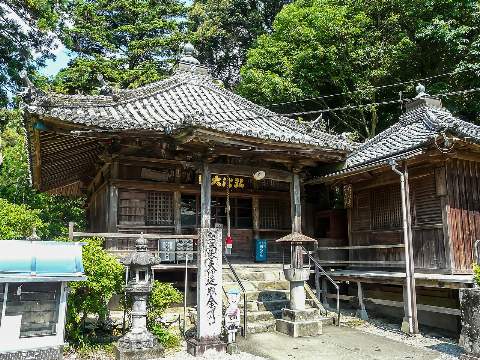
Photo : Naokijp, CC BY-SA 4.0, Wikimedia Commons
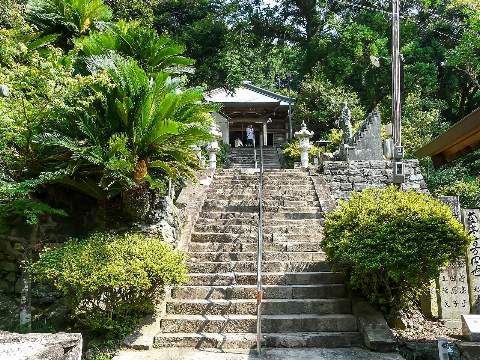
Photo : Naokijp, CC BY-SA 4.0, Wikimedia Commons