On kakakabi sanmaei sowaka
〒773-0017 徳島県小松島市立江町若松13番地
200 places. Check-in from 1 pm to 5 pm. Per person, tax included: room only 6,000 yen, with breakfast 6,500 yen, with dinner 7,000 yen, with 2 meals 8,000 yen (temple rates since 1 October 2024). Booking by phone only, at least one day ahead.
Prices checked on 16/11/2026 · source
👁️ Street View in front of the temple 🧭 Directions with Google Maps (to the temple gate) 🚗 By car: to the car park 📍 Open in a map app
Temple map
Buildings found in OpenStreetMap. Faded: uncertain position. The map may be incomplete: a building missing here may still exist on site. See the temple in Google Maps ↗
Blue: trail from the previous temple · red: to the next temple · 🛖: henro goya (hut). Tap a trail to open Street View at that spot.
- km 3,5 · n°48 Kyōzuka-an ヘンロ小屋第48号 京塚庵 · Street View
🪨 3 Shinnen milestones (1687) are reported on this stage : Komatsushima-shi, Kushibuchi-chō Hisatomo (emplacement ou état incertain) ; Komatsushima-shi, Kushibuchi-chō Miyanouchi (emplacement ou état incertain) ; Komatsushima-shi, Kushibuchi-chō Nakata, Jizō-dō (déplacée). Learn more
- NISHIMURA · 3,9 km (à 0,7 km du chemin) · 5 500 ¥ · dortoir
- Guest house RAKUFU · 7,7 km (à 2,6 km du chemin) · 4 500 ¥ · chambre individuelle
- km 9,8 · n°11 Katsuura ヘンロ小屋第11号 勝浦 · Street View
🚗 To temple 20 Kakurin-ji : 15.3 km · 30 min by car
Pilgrims’ trail from OpenStreetMap; walking time computed from the terrain, plus half for breaks.
🗺️ All the stages at a glance: on foot or by public transport →
History
Imperial founding and the vow of Enmei Jizō
According to tradition, Gyōki founded the temple under the reign of Shōmu (724–749). For the childbirth of Empress Kōmyō, he is said to have carved a gilded statuette of Jizō Bosatsu 5.5 centimetres high. Named Enmei Jizō, it is said to have been enshrined in a monastery of seven halls at Shimizu Oku, further west.
Kōbō Daishi’s intervention and the statue within a statue
According to this story, Kōbō Daishi came in 815. To keep the statuette from being lost, he is said to have placed it at the level of the heart of a 1.90-metre statue of Enmei Jizō, and named the place Tatsue-ji.
Medieval destruction and the first “checkpoint” of the pilgrimage
Burned around 1582 by the troops of Chōsokabe Motochika, the temple was rebuilt on its present site early in the 17th century with the support of Hachisuka Iemasa. The statue was spared. Tatsue-ji is the Shikoku no Sō-sekisho, the “great checkpoint”: according to belief, Jizō judges the faults of pilgrims here.
Sources: Official website of Tatsue-ji ; Shikoku 88 Temples Association — Tatsue-ji ; Tokushima Tourism (Awanavi) — Tatsue-ji.
Description
A majestic complex in the heart of the town
Standing in the centre of the town of Tatsue in Komatsushima, Tatsue-ji is one of the most imposing and venerated sanctuaries of Tokushima. You enter the precinct over the Shirasagi-bashi (the “white egret bridge”), where, according to legend, an egret appeared to Gyōki to show him this sacred spot. The whole place has the authority of a great monastery (a bekkaku honzan of the Kōyasan Shingon school), known for its prayers for the protection of mothers and children (Koyasu Jizō).
The Okyō hall and the painted ceilings of the Hondō
To the right of the Daishidō stands the Okyō-dō, a small oratory linked to an emblematic legend of the pilgrimage: in the early 19th century, a traveller named Okyō, guilty of adultery and murder, is said to have seen her hair rise and wrap violently around the bell rope as she tried to pray; freed after a sincere repentance, she had her head shaved on the spot. Her offered hair and the rope are still kept there. The main hall (Hondō), rebuilt in 1977 after a fire in 1974, is remarkable for its coffered ceiling decorated with 286 traditional paintings of flowers and birds by masters of the Tokyo University of the Arts (Geidai).
Sources: Official website of Tatsue-ji ; Shikoku 88 Temples Association — Tatsue-ji ; Tokushima Tourism (Awanavi) — Tatsue-ji.
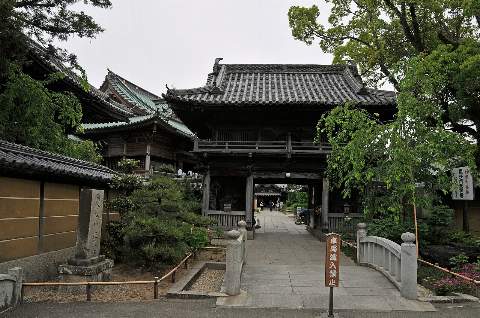
Photo : Reggaeman, CC BY-SA 3.0, Wikimedia Commons
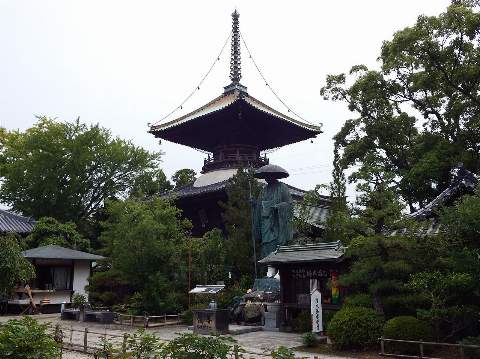
Photo : Dokudami, CC BY-SA 4.0, Wikimedia Commons
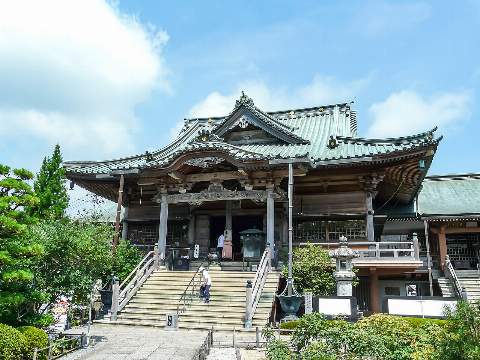
Photo : Naokijp, CC BY-SA 4.0, Wikimedia Commons
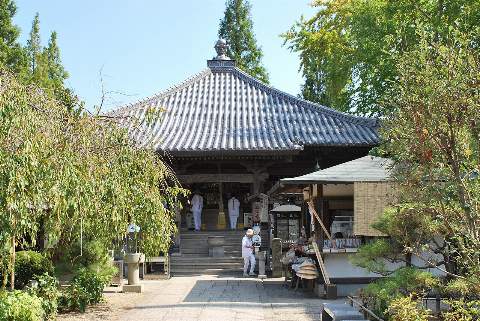
Photo : Reggaeman, CC BY-SA 3.0, Wikimedia Commons