Introducing Shikoku
Hachijūhachi kasho: what is it?Kōbō Daishi (Kūkai)The spirituality of the Shikoku pilgrimage: walking together
Japan consists of 4 main islands:
- Hokkaido in the north (Sapporo)
- Honshu, the main island where Tokyo, Kyoto, Osaka, and Hiroshima are located
- Shikoku, to the west, separated from Honshu by the Seto Inland Sea, Setonaikai (瀬戸内海)
- Kyushu in the south (Kagoshima, Fukuoka, Nagasaki)
Shikoku is the smallest of these 4 islands, with an area of about 19,000 km² and an estimated population of 4 million inhabitants. The population density is also much lower than the national average: 205 inhabitants per km² compared to 350 for Japan and even 387 for the main island of Honshu.
Shikoku in Japanese means the 4 ('四) countries/lands (国). Indeed, the 4 provinces of Shikoku from feudal Japan became 4 prefectures:
- The province of Iyo became Ehime Prefecture, and its capital is Matsuyama
- The province of Sanuki (famous for its udon) became Kagawa, and its capital Takamatsu
- The province of Tosa (birthplace of the famous Sakamoto Ryōma) became Kōchi
- And finally the province of Awa became Tokushima Prefecture.
Naturally, Shikoku is famous for its pilgrimage of the 88 temples and its 1,170 km (if visiting only the main temples). It is also known for the Awa Odori dance festival held from August 13 to 15 in Tokushima.
Access to Shikoku
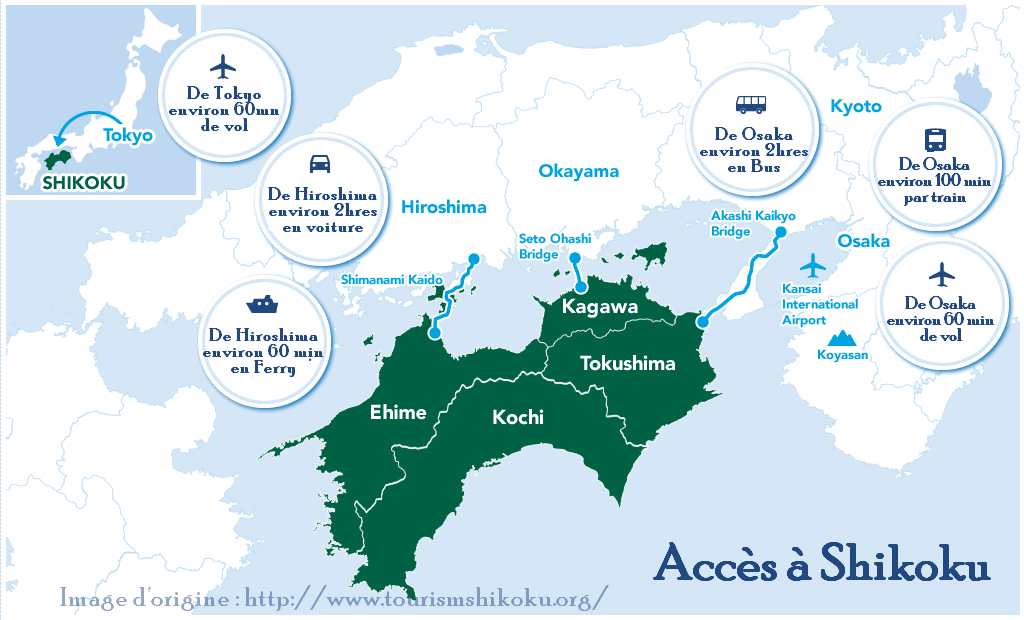
From Tokyo:
- Haneda Airport --> Takamatsu Airport: 1h20 min flight
- Haneda Airport --> Matsuyama Airport: 1h25 min flight
- Haneda Airport --> Tokushima Awaodori Airport: 1h15 min flight
- Narita Airport --> Takamatsu Airport: 1h25 min flight
- Narita Airport --> Matsuyama Airport: 1h40 min flight