Hachijūhachi kasho: what is it?
This is the short name that Japanese people give to the Shikoku pilgrimage (the large island across from Hiroshima). The main route consists of 88 temples.
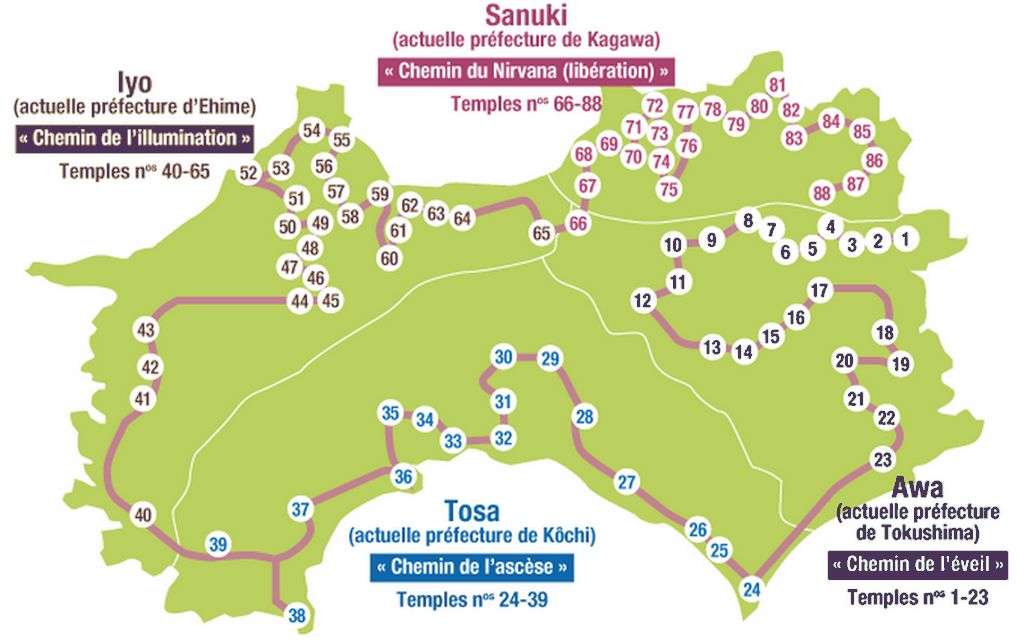
Hachiju hachi kasho (八十八ヶ所) means in Japanese the 88 places. Indeed, it is a spiritual journey (and religious for Buddhists) connecting 88 main temples on the island of Shikoku in western Japan. It follows the footsteps of the famous monk Kūkai, also known as Kōbō Daishi. The length of the Shikoku pilgrimage is approximately 1,140 km if visiting only the 88 temples. But it can reach 1,400 km if walking to all sacred sites associated with Kōbō Daishi, especially the 20 Bangai temples. Most temples belong to the Shingon school (the word sect is also used; there are several branches of Shingon Buddhism in Japan), though not all.
It crosses the four prefectures of Shikoku (Tokushima, Kōchi, Ehime, Kagawa), each prefecture corresponding to a section of the path leading to spiritual awakening.
This pilgrimage is said to be 1,200 years old, but it became especially popular at the beginning of the Edo period following the publication of a guidebook in 1689 by the Buddhist monk Yūben Shinnen.
The pilgrim is called Henro or O-henro, the O marking the respectful form. The pilgrimage is called Henro Michi (the pilgrim's trail) in abbreviated form. The pilgrim is usually dressed in white clothing (I will return to this in detail later). The pilgrim's walking stick, the kongōzue, is very important. Not only does it help with walking, especially on slippery trails, but it also symbolizes that one does not walk the pilgrimage alone. Indeed, Kōbō Daishi (Kūkai) accompanies us and helps us overcome difficulties. Inscribed upon it is Dōgyō Ninin (同行二人). This means that you are not alone on the pilgrimage trail; Kūkai is always by your side.
At each temple, one must burn incense, light a candle, and recite sutras. You have your nōkyōchō stamped and calligraphed. Here too, I will return later in detail to these rituals.
Unlike the pilgrimage to Santiago de Compostela, its Western older brother, all modes of transportation may be used, walking pilgrims (aruki henro) being a minority. Nor is there any obligation to complete the circuit all at once. Traditionally, one begins at temple number 1 Ryōzen-ji (霊山寺), but that is not mandatory either. Once arriving at the final temple, number 88 (Ōkubo-ji (大窪寺)), one completes the loop by returning to the starting temple. Then, once the circuit of the 88 temples of Shikoku Island is finished, the pilgrim must visit the mausoleum of Kūkai on Mount Kōya (Kōya-san 高野山) near Osaka.