Namu Daishi Henjo Kongo
Homage to the Savior [Kōbō] Daishi, the awakened and eternal one.
Pilgrimage
Namu Daishi Henjō Kongō (南無大師遍照金剛) is a sacred chant found on much of the Shikoku pilgrim's gear. It is a devotional mantra (naiten) of Shingon Buddhism honoring its founder Kūkai (Kōbō Daishi). Let us look at its meaning:
南無 Namu is an expression of deep reverence, akin to Ave in Latin or Amen in Christian tradition, originating from Sanskrit Namas.
大師 Daishi is the posthumous title given to Kūkai, meaning Great Master in the sense of one who has attained supreme knowledge and shares it.
遍照 Henjō signifies universal illumination in the Buddhist sense, designating a being who has attained awakening and sheds light everywhere.
金剛 Kongō can be translated as diamond, but in its Sanskrit sense (vajra), it represents that which is indestructible and eternal. It is the Buddhist symbol of indestructible truth.
Miyata Taisen, a specialist in the Shikoku pilgrimage and Shingon Buddhism, offers this translation:
Homage to the Savior [Kōbō] Daishi, the awakened and eternal one.
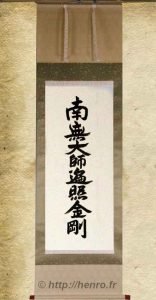
Since the 16th century. Pilgrims were already writing this phrase on the walls of the Sanuki Kokubun-ji (temple 80) in 1513, and at temple 49, Jōdo-ji, in 1527. For historians, it shows that the circuit of Shikoku had by then become a pilgrimage centered on Kōbō Daishi.
- In English
- Tribute to the Savior [Kōbō] Daishi, the awakened and the eternal.
In the same category
Aruki Henro 歩き遍路Bangai 番外Bekkaku 別格Daishidō 大師堂Dōgyō Ninin 同行二人Fudasho 札所Gohōgō 御宝号Goshuin 御朱印Gyaku uchi 逆打ちHenro 遍路Henro Goya 遍路小屋Henro korogashi 遍路ころがしHenro michi 遍路道Hyōseki 標石Ikkoku Mairi 一国参りJun-uchi (順打ちJunrei 巡礼Kechigan 結願Kōya-san 高野山Kugiri-uchi 区切り打ちNojuku 野宿Nōkyō 納経Nōkyō-chō 納経帳O-settai お接待Ohenro-san お遍路さんOrei-Mairi お礼参りOsamefuda 納札Sanmon 山門Sendatsu 先達Settai 接待Shingon 真言Shukubō 宿坊Tōshi-uchi 通し打ちTsūyadō 通夜堂Michishirube 道標Hechi 辺地・辺路Rokujūrokubu 六十六部Chōishi 丁石・町石