Michi no eki: roadside stations for Shikoku pilgrims
What is a michi no eki?
A michi no eki (道の駅, literally “roadside station”) is a rest area along a national highway or prefectural road. The network was launched in 1993 by the Japanese Ministry of Transport, and each station is managed by the municipality or a local public-private company. Today there are more than a thousand of them in Japan, and Shikoku has plenty: because the henro michi often follows major roads, the walking pilgrim encounters them regularly.
They are easy to spot from afar thanks to road signs marked 道の駅. You will generally find:
- restrooms open day and night, clean, with drinking water;
- a large free parking lot, benches, and often an awning;
- a shop selling local products: fresh fruits and vegetables of the day, regional specialties, bentō, pastries, souvenirs;
- often a small restaurant or cafeteria, and drink vending machines;
- tourist and road information about the region;
- in only some locations, an onsen, showers, or a coin laundry: check beforehand before relying on them.
A valuable halt for the walking pilgrim
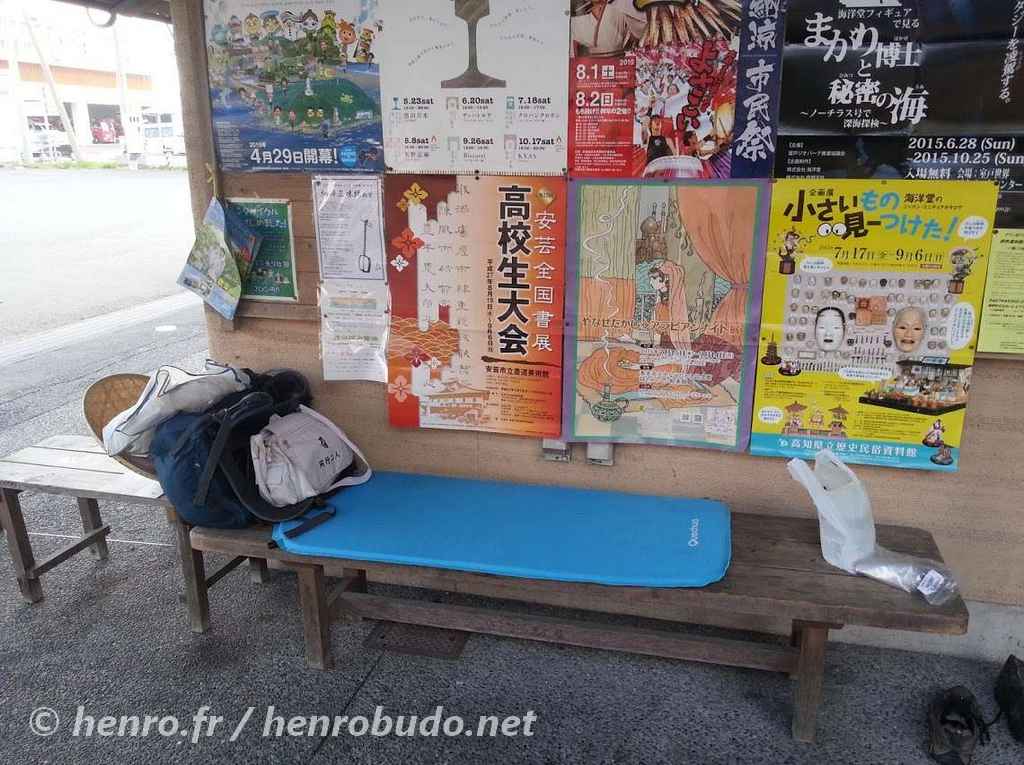
For the aruki henro, a michi no eki is first and foremost a welcome rest stop: you can sit in the shade, refill your water bottle, use the restrooms, and resupply. Products in the shop are often fresher and more varied than those at a convenience store, and much cheaper than at a restaurant. It is also a good place to ask for directions or weather updates: the staff are accustomed to seeing pilgrims pass through.
On a long stage with neither temple nor village, identifying michi no eki in advance helps you better organize your day.
Can you sleep there?
Many Japanese pilgrims practicing nojuku (sleeping outdoors) spend the night there, on a bench or under an awning, to take advantage of the 24-hour restrooms. However, it is not an accommodation facility: depending on the rest area, it is tolerated or prohibited, and a sign sometimes indicates this (野宿禁止, “no sleeping outdoors”, or キャンプ禁止, “no camping”). When in doubt, the simplest approach is to ask the staff during the day.
Our advice: it is best avoided. Michi no eki are very noisy at night, with constant car and truck traffic, engines idling for air conditioning in summer, bright lights, and, during warm weather, mosquitoes. A henro goya, tsuyadō, or zenkonyadō offers much quieter nights.
If you genuinely have no other option:
- settle in late, after the shop closes, and away from the parking area;
- no tents without permission, and never light a fire;
- leave early in the morning, before opening, leaving the area completely spotless.
Good to know
- Shops and restaurants close in the late afternoon or early evening: only restrooms, parking, and vending machines remain accessible at night.
- Michi no eki appear on road maps and in most Japanese navigation apps: convenient for planning your stages.
- For other ways to sleep during the pilgrimage, see the articles in the series below.